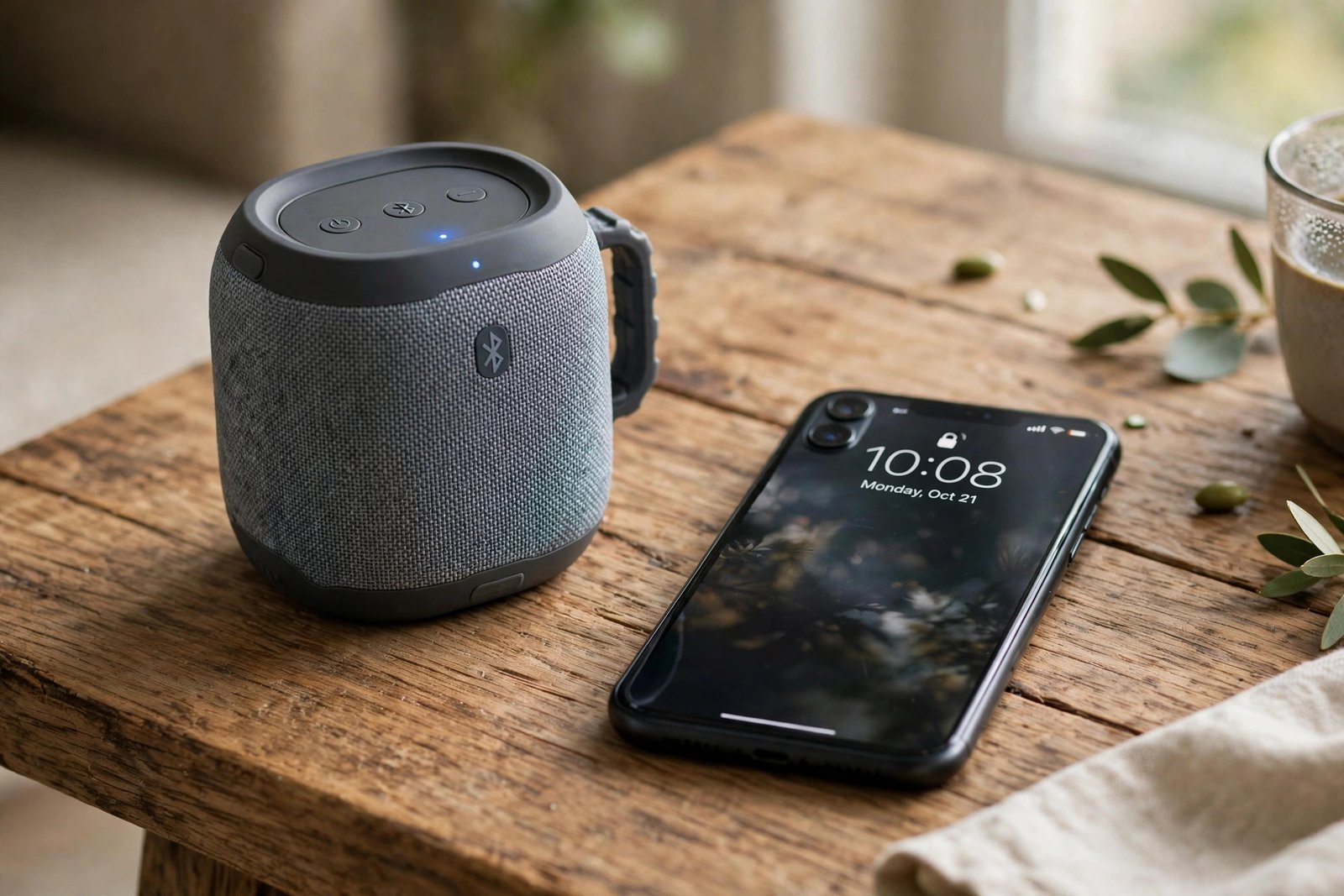
Walk into any electronics shop or browse any online store and you will find a wall of speakers that all promise big sound, long battery life and rugged design. Choosing a bluetooth speaker should be simple, but the sheer choice makes it confusing: tiny pocket speakers, chunky outdoor models, stylish home speakers and party speakers all claim to do everything, and they plainly do not. This buying guide cuts through that noise by focusing on what actually matters for how you will really use a speaker — sound, size, battery, durability and connection — and by showing you the mistakes that lead people to buy the wrong one.
The most important idea in this guide is also the simplest: there is no single best Bluetooth speaker, only the best speaker for a particular job. A speaker that sounds wonderful in a quiet living room may be too quiet in a garden, too fragile for a beach, or too heavy to carry on a walk. Start from where you will listen, who will listen with you, and how you will carry and charge the speaker, and the right choice usually becomes clear long before you compare feature lists.
Sound Quality: What Actually Matters
Sound quality is the reason to buy a speaker, yet it is the hardest thing to judge from a product page. Numbers and marketing terms tell you very little about how a speaker will sound in your room or garden, because volume alone is not quality. A speaker that plays loudly but sounds harsh, muddy or distorted at higher volumes is less enjoyable than a quieter speaker that stays clear and balanced. When you listen, pay attention to voices first: speech should sound natural and easy to follow, not muffled or tinny. Then listen for balance across the music you actually enjoy, whether that is acoustic songs, electronic tracks, podcasts or classical pieces, rather than judging a speaker only on one dramatic bass-heavy track.
Bass deserves a balanced view. Deep bass can make music feel full and enjoyable, but excessive bass can drown out vocals and detail, especially in a small room. A good speaker keeps bass controlled and musical rather than boomy, and lets you hear instruments and voices clearly at the same time. Stereo separation is another factor worth understanding: a single small speaker can still sound spacious, but two speakers paired together, or a wider speaker with drivers spread apart, will generally give a more open soundstage than a tiny mono unit. If you mainly listen alone at a desk, that difference may matter less; if you listen across a room with other people, it matters more.
Wherever possible, listen before you buy, using music you know well. A familiar track reveals differences instantly in a way that a shop demonstration track may hide. Listen at the volume you will actually use, not only at maximum volume, and try the speaker in a space similar to where it will live if you can. If you are buying online, read reviews that describe sound in plain language and compare several sources, and check the return policy so you can test the speaker at home with your own music and send it back if it does not suit your ears. Sound is personal, and a speaker that reviewers love can still be wrong for your taste.

Size, Portability and Battery: The Trade-Off
Size is the single biggest trade-off in speaker buying. Small speakers are easy to carry, slip into a bag or jacket pocket, and move from room to room without thought. Larger speakers generally sound fuller, play louder without strain, and hold a bigger battery, but they are heavier, harder to carry, and less convenient for travel. There is no way around this trade-off, so be honest about how portable the speaker really needs to be. A speaker that lives on a kitchen shelf does not need to be pocket-sized; a speaker for walks, cycling trips or holidays must be light enough that you will actually take it with you.
Battery life should be judged the same way: by your real use, not by the headline claim. Battery performance varies with volume, so a speaker played loudly outdoors will not last as long as the same speaker played quietly indoors, and any published figure is best treated as a guide under favourable conditions rather than a promise. Think about your longest typical listening session, whether you will have easy access to charging, and whether the speaker charges with a common cable you already carry. A speaker that needs a special charger you keep forgetting is less useful than one that charges with the cable already in your bag. It is also worth checking whether the speaker can play while charging, which matters if you use it at a desk or bedside for long periods.
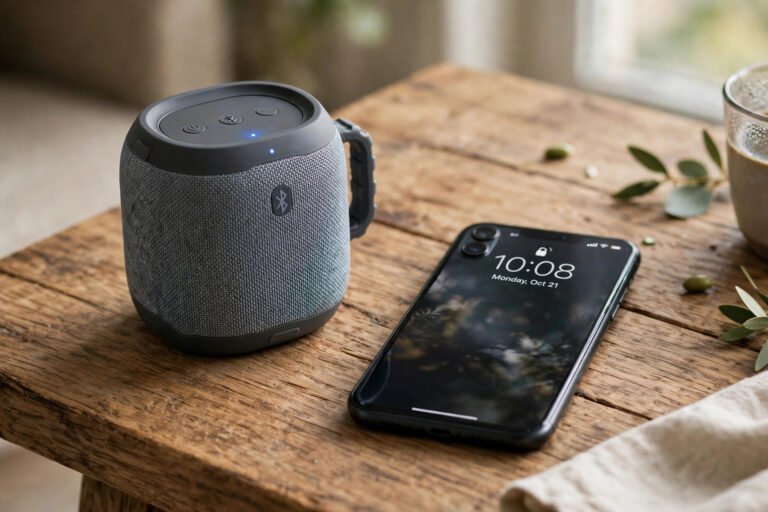
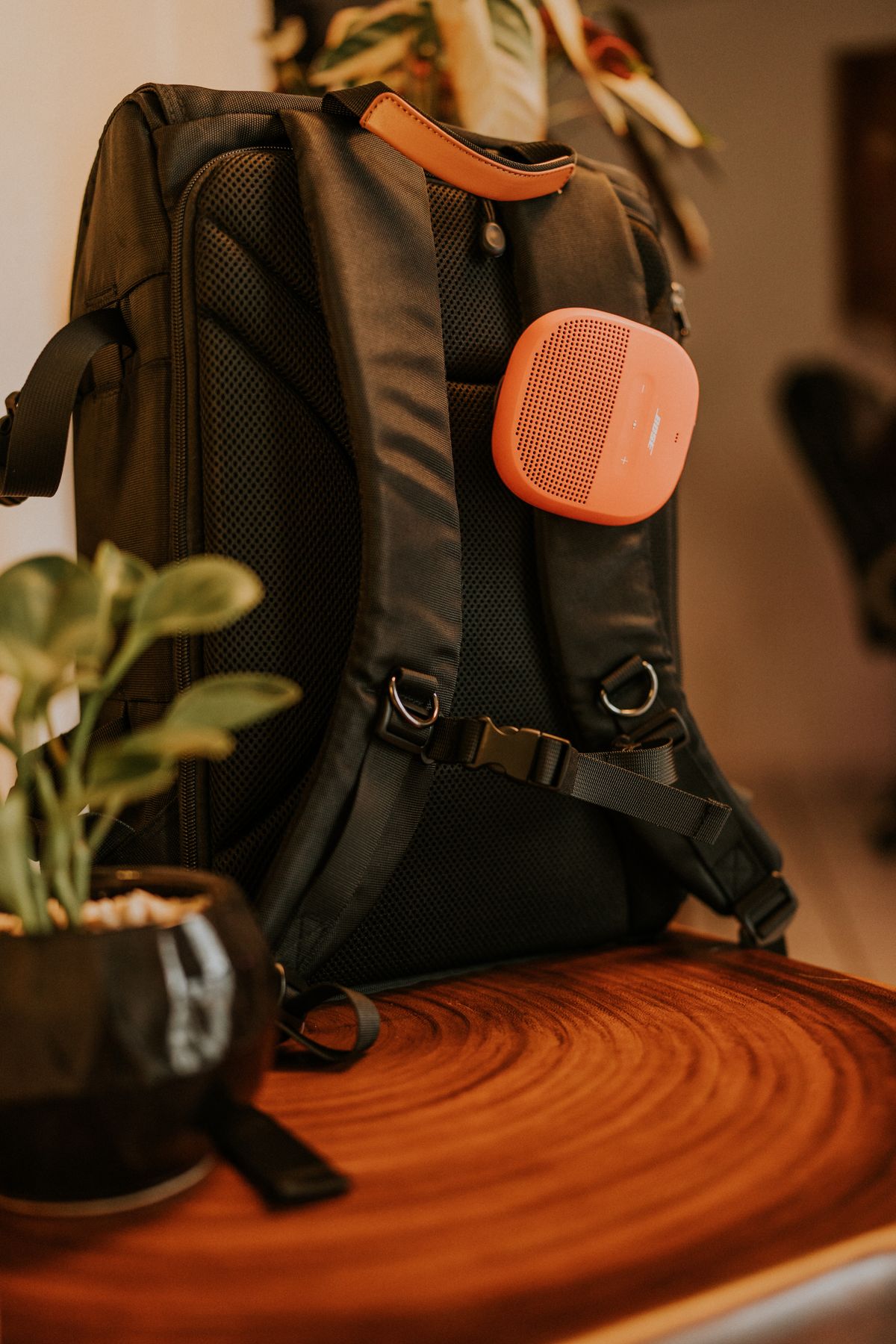
Weight and shape matter as much as size on paper. A speaker with a handle, a loop or a carabiner clip is far easier to carry outdoors than a smooth, heavy cylinder of the same dimensions, while a speaker with a flat base sits more securely on a shelf or table than one that rolls. If you plan to use the speaker in a bag, check that the controls will not be pressed accidentally and that the speaker will not be damaged by other items. These small practical details decide whether a speaker becomes a daily companion or stays at home gathering dust.
Waterproofing, Dust Resistance and Build Quality
If a speaker will ever go near water, sand, mud or rain, durability is not a luxury; it is the point. Speakers are sold with different levels of water and dust resistance, and the wording matters. A speaker described as splash-resistant can cope with light rain or splashes, but that is not the same as a speaker designed to survive being dropped in water or left out in heavy rain. Read the stated resistance carefully, and do not assume that a rugged look guarantees rugged protection. A rubberised coating and a sturdy grille look tough, but only the stated rating tells you what the speaker is actually designed to withstand.
Even a well-protected speaker needs sensible care. Rinse off sand and salt water where the maker advises it, let the speaker dry before charging if it has been wet, and keep charging ports covered or closed as designed. Drop protection is a separate question from water protection: a speaker can survive a splash and still be damaged by a hard fall onto concrete, so check how the speaker is built, whether corners are protected, and whether it is meant to float or sink if dropped in water. For beach and pool use, a speaker that floats or is easy to retrieve is a genuine practical advantage, not a gimmick.
For indoor use, build quality still matters, but in a different way. A speaker that lives in a kitchen needs to cope with steam, splashes and greasy fingers; a speaker in a child’s room needs to survive knocks and spills; a speaker on a desk needs stable feet that do not vibrate across the surface at higher volumes. Look at the materials, the feel of the buttons, and whether the speaker sits securely where you will put it. A well-built speaker that suits its environment will outlast a more impressive-sounding model that was never designed for that place.
Connection, Range and Multi-Room Use
A Bluetooth speaker connects to your phone, tablet or laptop without wires, which is the whole appeal, but not all wireless connections behave the same in real homes. Bluetooth range is affected by walls, distance and interference from other wireless devices, so a speaker that works perfectly in the same room may stutter when you walk into the kitchen with your phone in your pocket. If you plan to move around while listening, test the connection at the distances and through the walls you will actually use, and remember that keeping the phone near the speaker is the simplest fix for most dropouts.
Some speakers also offer wireless home network connection, auxiliary wired input, or the ability to pair two speakers together for stereo sound or to play the same music in different rooms. These features are genuinely useful, but only if you will use them. A wired input is valuable if you want to connect an older device without Bluetooth; pairing is valuable if you want wider sound or music across a home; home network features are valuable if you want the speaker to work independently of your phone. Do not pay for a feature list you will never use, and do not ignore a feature you will miss every day, such as the ability to connect a second speaker later.
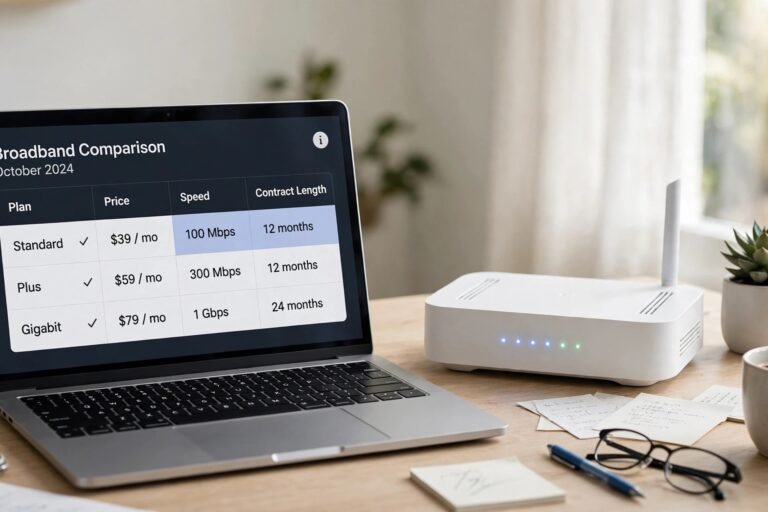
At home, a wireless speaker also depends on the quality of the home network around it, particularly if it streams over your home connection rather than directly from your phone. A weak or congested home network can cause buffering and dropouts that look like a speaker fault but are really a connection problem. Our guide to broadband offers explains how to compare UK broadband deals by total cost, speed and contract terms, which is useful background if your home connection is the weak link in your listening setup. Fixing the connection first can make an existing speaker sound better than buying a new one.
Types of Bluetooth Speaker for Different Uses
For a living room or bedroom, a larger speaker that prioritises sound quality over portability usually wins. It can sit in one place, stay plugged in or charged, and fill the room without strain. Look for clear voices, balanced bass and controls that are easy to reach, and consider whether pairing a second speaker later would improve the sound across the room. Appearance matters here too, because a home speaker is on display; choose a design and colour you will be happy to live with, not only one that photographs well.
For outdoors, gardens, beaches and picnics, prioritise durability, portability and volume that carries in open air. Open spaces swallow sound, so a speaker that sounds ample indoors may seem quiet outside, and a speaker with no water or dust protection is a risky choice for a beach bag. A handle or clip, a rugged build and a battery that comfortably covers a day out matter more outdoors than subtle differences in sound finesse. For travel and commuting, the priorities flip again: small size, light weight, simple controls and easy charging matter most, because the best travel speaker is the one you actually pack.
For a desk, study or home office, a compact speaker that sounds clear at low to moderate volume is ideal, especially for podcasts, video calls and background music while working. Look for easy volume control, a stable base, and a connection that does not drop when you switch between devices. For gatherings and parties, a larger speaker with strong volume, wide sound and simple controls that guests can understand without instruction is the practical choice, while a speaker for a bathroom or kitchen should prioritise splash resistance and controls that work with wet hands. Naming your main use first narrows the field dramatically and prevents you from buying a speaker designed for a life you do not lead.
Smart Features, Apps and Voice Control
Many modern Bluetooth speakers include smart features: voice assistant support, companion apps for adjusting sound, multi-speaker control, and customisable sound settings. These can be genuinely helpful. An app that lets you adjust bass and treble to suit your room, set a sleep timer, or update the speaker’s software adds real value. Voice control can be convenient when your hands are full in the kitchen or your phone is across the room. But smart features also add complexity, and a speaker that depends heavily on an app can become frustrating if the app is slow, confusing or poorly maintained.
Before choosing a smart speaker, ask whether you will actually use the smart features, or whether you simply want good sound from your phone. If you do use an app, treat the account for that app like any other important account: use a unique password rather than reusing one from elsewhere, and keep the app updated. A password manager creates and stores strong, unique passwords, which makes managing app accounts far easier and safer. Also check whether the speaker works well without the app, so a future app change never leaves you with a speaker you cannot control.
Privacy is worth a moment of thought with any speaker that listens for voice commands. Check what the speaker records, how you can mute the microphone, and whether there is a clear physical mute control. A visible mute button you can trust is more reassuring than a setting buried in an app. If you do not want a listening speaker in a bedroom or bathroom, choose a simpler Bluetooth speaker without voice features; you will lose nothing in sound quality and gain peace of mind.
Mistakes to Avoid When Buying

The most common mistake is buying on loudness alone. A speaker that is impressive for a few seconds in a shop can become tiring to listen to at home, especially if bass overwhelms voices or treble sounds harsh. The second mistake is ignoring size and weight: a speaker that is too big to carry will not travel, and a speaker that is too small for a garden will disappoint outdoors. The third mistake is assuming that all water resistance is the same, as explained above; splash resistance, rain resistance and submersion are different levels of protection, and buying the wrong level for a beach or pool can ruin a speaker quickly.
Other mistakes are easy to avoid once you know them. Do not buy a speaker only because of a brand name or a familiar logo; brands make good and mediocre models alike, and the individual speaker matters more than the badge. Do not ignore the return policy when buying online, because sound is personal and a home trial is the only reliable test. Do not forget practical details such as charging cable type, whether the speaker can charge other devices, how the controls feel in the dark, and whether the speaker will sit safely where you plan to put it. Finally, do not buy the cheapest speaker that claims every feature; a speaker that promises everything at a rock-bottom level often does nothing well, while a simpler speaker that does its main job properly is a far better purchase.
A Simple Checklist Before You Buy
Use this short checklist to turn everything above into a decision. First, name your main use in one sentence: home listening, outdoor use, travel, desk work or gatherings. Second, choose a size you will actually carry or live with, and be honest about the trade-off with sound. Third, check the water and dust protection against the wettest, dustiest place the speaker will go, not the average place. Fourth, test the sound with music you know, at the volume you will use, and check voice clarity as well as bass. Fifth, confirm the connection works at the distances you need, and that any pairing or multi-room feature you want is genuinely supported. Sixth, check charging, battery behaviour in real use, and whether the controls suit your hands and your household. Seventh, confirm the return policy and warranty in writing, so a home trial is genuinely possible.
If a speaker passes that checklist, it is almost certainly a good buy for you, even if another model has a longer feature list or a more enthusiastic review. If it fails on your main use — too quiet outdoors, too fragile for the beach, too heavy to carry, or too muddy for voices — no other feature will compensate. Buying a speaker is not about finding the highest-rated model in the abstract; it is about matching a speaker to the rooms, gardens, bags and ears it will actually serve.
Frequently Asked Questions
Is a bigger Bluetooth speaker always better?
Not necessarily. Bigger speakers often sound fuller and play louder, but they are heavier and less portable, and a well-designed compact speaker can sound better than a poorly designed large one. The right size depends on where you will listen: a bedroom or desk suits a compact speaker, while a garden or gathering suits a larger one. Judge by your use, not by size alone.
Can I use a Bluetooth speaker for phone calls and video meetings?
Many Bluetooth speakers include a microphone and can handle calls, but call quality varies greatly. Some speakers are clear for both sides of a call, while others pick up room echo or sound distant to the other person. If calls matter to you, test the microphone in a real call before relying on it for work, and check whether the speaker handles switching between music and calls smoothly.
What does water resistance actually mean for a speaker?
It means the speaker is designed to withstand a stated level of water exposure, which can range from light splashes to heavy rain or brief submersion, depending on the rating. Always read the stated rating rather than relying on words like rugged or waterproof alone, and follow the maker’s guidance on drying and charging after the speaker gets wet. A speaker that survives splashes may not survive being dropped in a pool.
Do I need a smart speaker, or is a simple Bluetooth speaker enough?
For most people, a simple Bluetooth speaker is enough. Smart features are worth having only if you will use voice control, app sound adjustments or multi-room control regularly. If you mainly play music from your phone, a simpler speaker gives you the same sound with less complexity, fewer accounts to manage, and no listening microphone to think about.
Conclusion
Choosing a bluetooth speaker becomes straightforward once you start from your own listening life rather than a feature list. Decide where the speaker will live and travel, how loud and clear it needs to be in that space, how much water, dust and knocks it must survive, and how you will charge and control it day to day. Test sound with music you know, check the protection rating honestly, and make sure the return policy lets you try the speaker at home. A speaker chosen that way will not be the loudest or the most featured model on the shelf, but it will be the one you reach for every day — and that is the only measure of a good purchase that really counts.
About the Author